The Mindset Behind Achievement
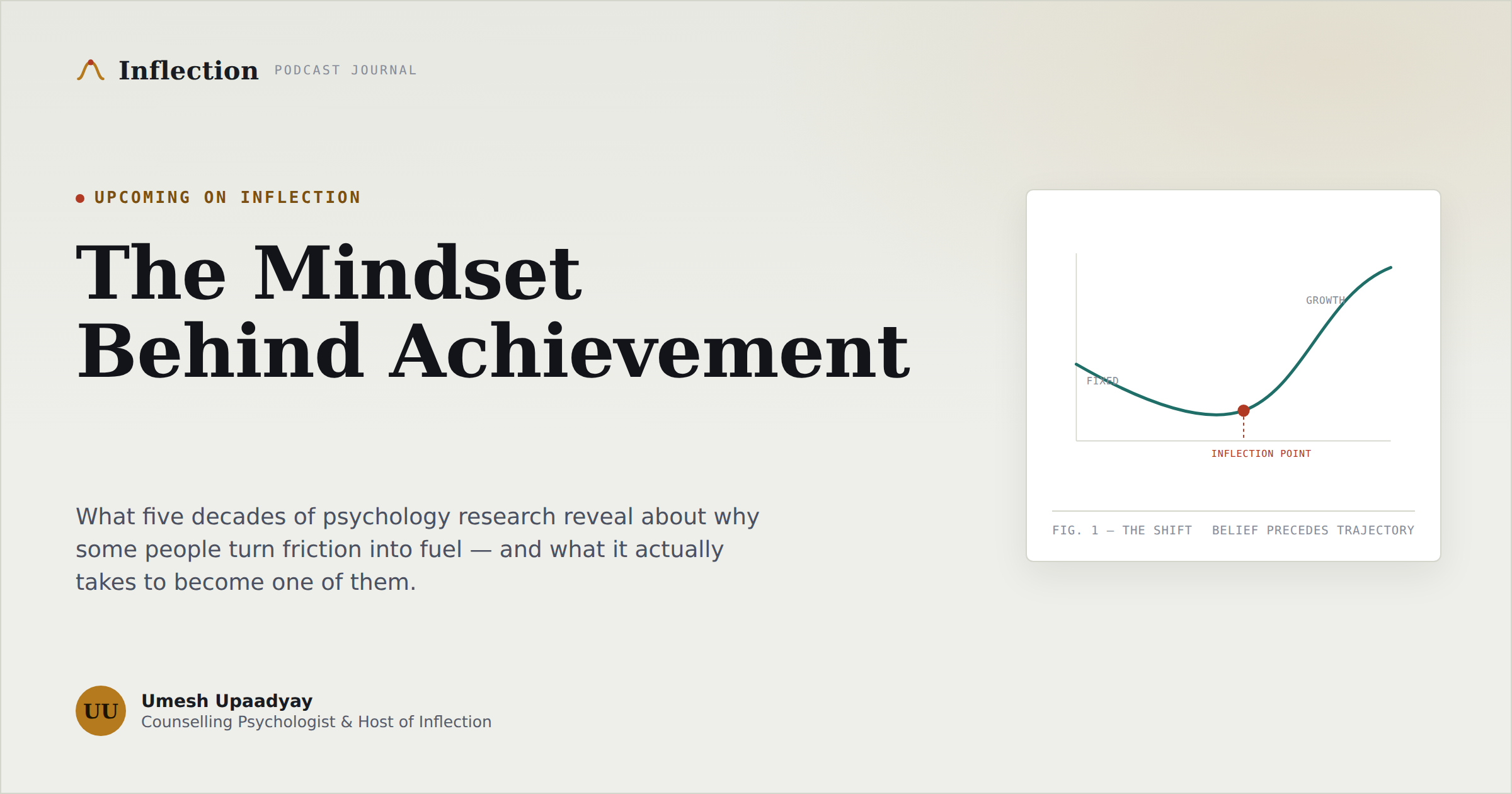
Talent gets the applause. It rarely gets the credit it's actually owed, because the research keeps pointing somewhere else. Across classrooms, workplaces, and elite selection courses, the sharpest predictor of who breaks through isn't raw ability. It's what a person believes about that ability in the moment it's tested.
That question - not what did you achieve, but what did you believe about yourself right before you achieved it - is the thread running through this season of Inflection. Before we sit down with the founders, clinicians, and comeback stories on the show, it's worth looking at what the data actually says about the mindset behind achievement.
TWO THEORIES OF ABILITY, ONE VERY DIFFERENT TRAJECTORY
Stanford psychologist Carol Dweck's core distinction is simple: people with a fixed mindset treat intelligence and talent as traits you either have or don't. People with a growth mindset treat ability as something built through effort and strategy. The interesting part isn't the theory - it's what happens when you change the belief and measure the outcome.
In 2019, researchers ran the largest controlled test of this idea to date: the National Study of Learning Mindsets, published in Nature. A nationally representative sample of 12,000 American ninth-graders across 76 public high schools sat through a single 50-minute online module teaching them that intellectual ability isn't fixed.
The result: an average GPA gain of +0.10 versus the control group, and a drop of more than 5 percentage points in students earning mostly D's and F's. One class period moved the needle - most for lower-achieving students in schools where peer norms already supported the idea that ability could grow. Higher-achieving students who got the same module were more likely to opt into harder math courses the following year.
IT SHOWS UP AT WORK, LONG BEFORE PERFORMANCE REVIEW SEASON
Dweck's later research, studying employees across seven Fortune 1000 companies, found the same split plays out at scale. Employees at growth-mindset companies were 34% more likely to feel committed to the company's future, showed 65% stronger agreement that the company supports risk-taking, and 49% stronger agreement that it fosters innovation. Their supervisors independently rated them as more innovative, more collaborative, and more likely to have management potential. Employees at fixed-mindset companies, by contrast, reported more cheating and corner-cutting - the cost of a culture where looking talented matters more than getting better.
THE TRAIT THAT PREDICTS SUCCESS WITHOUT PREDICTING TALENT
Angela Duckworth's concept of grit - sustained passion and perseverance toward long-term goals - is the closest thing psychology has to a mindset you can watch in action. A 2014 study in Frontiers in Psychology tracked grit's predictive power across elite military selection, sales retention, and high-school graduation. People one standard deviation higher in grit had 32% higher odds of completing elite Army special-operations selection, 40% higher odds of job retention among new sales hires, and 21% higher odds of graduating high school on time.
The detail that matters most: grit tracked closely with conscientiousness but was essentially unrelated to raw intelligence (r = −0.07) or physical fitness (r = 0.06). Persistence isn't a byproduct of talent. It's a separate lever — available to people regardless of where they started.
WHAT A FIXED MINDSET COSTS - MEASURED IN TRILLIONS
This isn't an abstract debate for HR decks. Gallup's State of the Global Workplace report shows only 20% of employees worldwide are engaged at work — the lowest level since 2020 — and low engagement costs the global economy roughly $10 trillion in lost productivity a year, about 9% of global GDP. Only 34% of employees globally report they are genuinely thriving in life. Engagement and mindset share a mechanism: both track whether people believe their effort can actually change their circumstances.
CAN A MINDSET REALLY BE TRAINED?
The honest answer: yes, but not through a poster on the wall. A few concrete mechanics, borrowed from the research above:
Praise the process, not the person. "You worked through that differently the second time" builds a growth belief; "you're so smart" quietly reinforces a fixed one.
Treat setbacks as data, not verdicts. The people who improved weren't the ones who failed less — they were the ones who treated failure as information about strategy, not identity.
Context outweighs willpower. The Stanford study's biggest effects showed up in schools where the environment already reinforced the belief. Mindset isn't purely internal — it's shaped by the rooms, teams, and relationships a person is in.
Add the word "yet." It sounds small. In Dweck's classroom research, it was one of the most reliable single-word interventions for shifting a student's response to a wrong answer.
These are exactly the mechanics behind three of the conversations coming up on Inflection this season — Redefining Success, The Mindset Behind Achievement, and Lessons from Setbacks — each one built around a guest whose own inflection point started with a belief they had to unlearn first.
New episodes of Inflection explore the real, unpolished decisions behind the people who changed direction. Subscribe on your platform of choice so you don't miss it.
Sources: Yeager et al. (2019), Nature — National Study of Learning Mindsets; World Economic Forum, citing Dweck's Fortune 1000 research; Eskreis-Winkler et al. (2014), Frontiers in Psychology; Gallup, State of the Global Workplace.